Autonomy wins the drone wars.
SmartPilot is a universal autonomy module. It adds terminal, failsafe, flight and geolocation autonomy to an existing UAV, without replacing its flight controller.
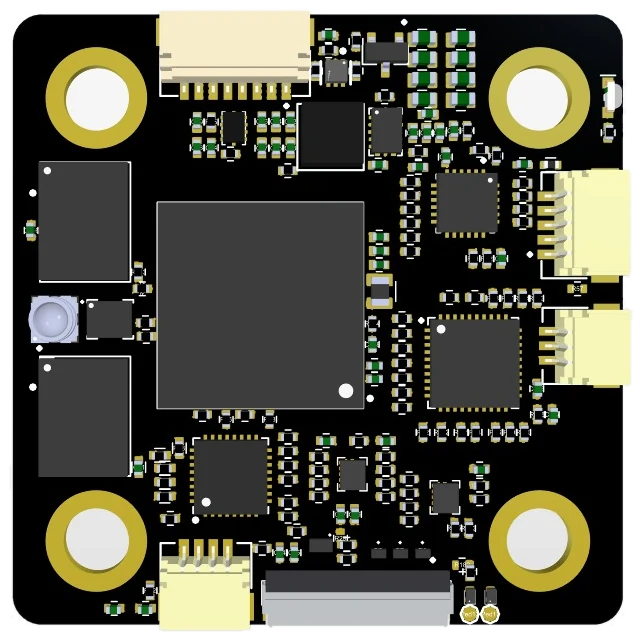
 SmartPilot42 mm module for your own airframe
Four problems. One board.
Every drone flight depends on things that fail. Today each one is solved, if at all, by a separate product with its own hardware, weight, power and integration. SmartPilot solves all four on one 19 g board, next to the flight controller you already fly.
FPV missions flown by hand succeed only about 10–15% of the time; autonomous guidance raises success to about 70–80%, with one or two drones per target instead of eight or nine. CSIS, Mar 2025
One vendor reports a brigade rising from about 20% to 71%. Forbes, Aug 2026
Lock the whole target, or one exact point on it.
SmartPilot tracks a target in the camera image, in the air or on the ground, and flies the final approach. The operator chooses what it holds: the whole object, or one point of it.
Operator in command
The operator chooses and confirms the target. SmartPilot never takes over on its own, and the operator can take control back at any moment.
A lost link no longer means a lost drone.
Without GNSS and in acro mode, a drone that loses its link to the pilot has nothing to keep it in the air: it falls or crashes. SmartPilot keeps flying it.
Configurable
You choose how long it waits, and whether it then lands or returns home.
Fewer drones lost to a dropped link means a more reliable fleet and more flights from every airframe.
Easy to fly, even without GNSS.
Without GNSS, the flight controller runs in acro mode, where the pilot flies every axis by hand and it takes months to become proficient. SmartPilot keeps the flight controller in acro mode and does that hand-flying itself, from its camera. The operator gets the ease of loiter mode: the sticks set direction and speed, and the drone stays level and stops when they are released.
Acro mode, loiter-mode ease
The flight controller stays in acro; SmartPilot turns the operator's stick inputs into steady flight.
Operators in hours, not months
No long acro training before the first mission.
Eyes on the mission
The operator watches the target, not the drone's balance.
Knows where it is, without GNSS.
SmartPilot works out the drone's position from its camera, by matching what it sees to a map. Jamming or spoofing satellite signals doesn't leave it lost.
Map loaded before flight
Choose the area on our web platform and load its map onto the drone before take-off.
Position from the camera
In flight, SmartPilot matches the camera view to the map to know where the drone is.
Navigate by it
The drone flies and navigates on that position, with no satellite signal at all.
- PX4
- ArduPilot
- Betaflight
- INAV
FPV drones
Standard FPV quadcopters
Interceptors
High-speed air-to-air drones
Fixed-wing
Small fixed-wing aircraft and flying wings
Aerial
UAVs and loitering munitions
Ground
Armor and vehicles, moving or stationary
Naval
Surface vessels and fast boats
The hardware.
One board. Three connections.
A camera goes in, video goes out to the link you already use, and one UART connects it to the flight controller.
- Analog cameraCVBS
- CSI cameraMIPI CSI-2 ribbon
- USB cameraUSB UVC
- IPEX cameradigital, IPEX lead
*RTSP streaming requires compatible application firmware.
Dev kits get you a demo. Not a fleet.
NVIDIA Jetson and Raspberry Pi are great for prototyping, but they are general-purpose computers, not a sustainable way to field autonomy. We don't just sell a board: SmartPilot is a full-stack system, and its software keeps improving with frequent updates.
| Criterion | Jetson / Raspberry Pi | SmartPilot |
|---|---|---|
| Built for | Lab prototyping | The airframe |
| Mounting & power | Custom brackets, separate regulator | Standard FPV stack, powered by the FC |
| Start-up | Full operating system to boot | No operating system to boot |
| Software | Yours to build and maintain | Full stack, updated frequently |
The numbers.
Specifications are subject to change.
Processor & compute
- Main MCU
- STM32N657X0
- CPU
- 1× Cortex-M55 @ 800 MHz
- Internal NPU
- 0.6 TOPS Neural-ART
- Internal GPU
- NeoChrom 2.5D
- Storage
- 64 MB Octo-SPI NOR flash
- Internal RAM
- 4.2 MB internal SRAM
- External RAM
- 64 MB external PSRAM
- Power input
- Regulated 5 V from FC BEC ≥ 3 A · reverse-polarity protected
Onboard sensors
- IMU
- 6-axis ICM-45686 (3-axis accelerometer + 3-axis gyroscope)
- Barometer
- BMP585 absolute pressure sensor
Video input & output
- Analog camera
- CVBS · JST-SH 4-pin
- Digital camera
- MIPI CSI-2 via FFC · up to 1920 × 1080 (1080p)
- USB camera
- USB 2.0 HS host (UVC) · 4-pin header
- IPEX camera
- Digital camera via IPEX connector
- Analog video out
- CVBS · PAL / NTSC to VTX
- Pipeline
- HW deinterlacer + TBC
- Modality
- Thermal & optical
- Format
- NTSC 720 × 480 @ 60i · PAL/SECAM 720 × 576 @ 50i
Communications & FC integration
- UART
- 2× UART (connector + solder pads) · 3.3 V or 5 V logic
- FC link
- UART @ 921600 · MAVLink or MSP
- RC link
- UART · CRSF direct receiver
- VTX OSD
- MSP DisplayPort over the FC UART
- Ethernet
- 10/100 Mbps · video output to IP radios
- Bus
- I²C ×1 · SPI ×1 (solder pads)
- Debug
- SWD on solder pads
Connectors
- Power in
- 8-pin · 5 V input (4× VIN, 4× GND)
- CSI camera
- 22-pin FFC, 0.5 mm · 2-lane MIPI CSI-2, camera I²C + power
- Analog camera in
- 4-pin · CVBS in, 5 V camera power, control, GND
- Analog video out
- 3-pin · CVBS out to VTX, control, GND
- USB camera
- 4-pin · USB 2.0 HS (5 V, D−, D+, GND)
- Ethernet
- 5-pin · 10/100 (TX±, RX±, shield)
- UART 1
- 3-pin · TX, RX, GND
- Solder pads
- UART 2 · SPI · I²C · SWD / reset · boot
Mechanical & environment
- Form factor
- 42 × 42 × 9 mm
- Mount
- 30.5 mm M3 dual stack
- Weight
- 19 g
- Operating temp.
- −20 to +70 °C
This is only the beginning.
Four kinds of autonomy today are steps toward fully autonomous drone piloting. Every software update makes the same board more capable.
Built on peer-reviewed work.
A telemetry-augmented Kalman filter for real-time FPV-to-FPV drone interception
Aerospace Science and Technology, vol. 177, 112202
doi:10.1016/j.ast.2026.112202 →More publications on the way
Further work on onboard detection, tracking and terminal guidance is in preparation. New papers will be listed here as they are published.
Be first to fly it.
Early-access units are limited. Join the waitlist to hear first when boards ship, and get product and software updates along the way.